
Hello, Goodbye.
In Praise of Stephen Colbert, the Talk Show Host who Led Late Night with Joy, Faith, and Feeling.
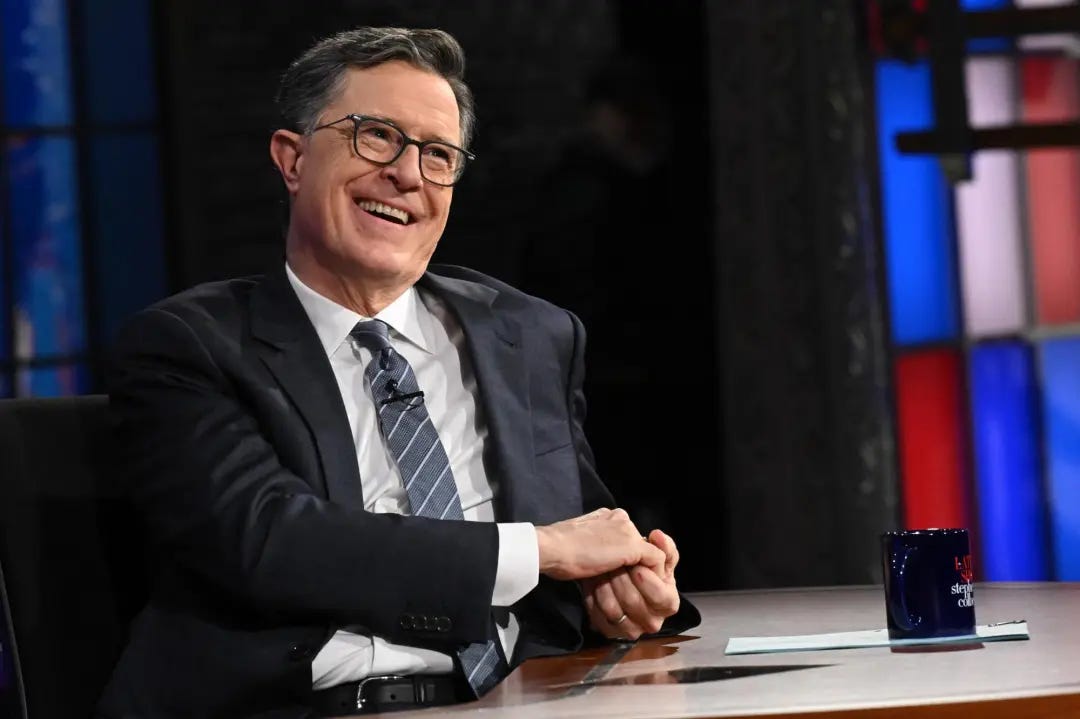
Stephen Colbert aired his final Late Show on CBS last night. He said, in comments to the audience before the show itself, “When we started The Colbert Report, I said, ‘Anyone can read the news to you. I promise to feel the news at you.’ I realized in this job that our job over here was different. Our job was to feel the news with you."
“And I don’t know about you,” he went on, with a grin, “but I sure have felt it.”
While Colbert himself replaced the legendary David Letterman in 2015, these last few weeks the idea of his last show has had more of the feeling of Johnny Carson’s retirement from The Tonight Show in 1992. In part it was the circumstances of his departure that have given the moment a greater solemnity, as Paramount announced it was not only replacing him but shuddering The Late Show franchise (and with it the historic Ed Sullivan Theater) entirely after 33 years, in circumstances that have been widely regarded as a payoff for the FCC approving Paramount’s merger with Skydance Media.
But the other reason that the last few weeks have had big “When Will Bette Midler Come Out and Make Johnny and All of Us Cry?” energy is simply the kind of person that Stephen Colbert has been in this role. The comedian had previously spent ten years playing a right wing egomaniac as the host of The Colbert Report, an incisive parody of Bill O’Reilly and his ilk that somehow also won their occasional amusement, if not their affection—so much so that they actually invited him to perform at the White House Correspondents Dinner in 2006, then were stunned when he serrated then-President George Bush and his administration to within an inch of its life.
It’s considered by many as the greatest Correspondents’ Dinner monologue ever.
Still, somehow after all that time playing a character that was definitely not him, Colbert stepped onto the stage of the Ed Sullivan Theater with an unexpectedly easy gravitas, like he’d been around doing the gig as himself for years.
Which is not to say that the ratings initially followed him. After debuting to over 8 million viewers, the very next day the show found itself up against Jimmy Fallon and The Tonight Show using every bell and whistle they could to pull focus away from Colbert. And as Bill Carter reported, for quite some time they succeeded.
It wouldn’t be until Donald Trump came into office that the show finally found its footing. For as much as Colbert loves a good chat about the Lord of the Rings, a conversation with musical theater legend Stephen Sondheim or a wormhole, his sweet spot has always been talking and laughing about politics, in an unexpected way.
When ABC host Jimmy Kimmel (or his hero David Letterman before him) talk about politics, it’s a knife fight. They have the blade in their hands and they’re going to thrust it into their enemies’ chests, repeatedly. When NBC’s Seth Meyers does so, it’s more in the Daily Show/Last Week Tonight mold, filled with research and intricate set ups and punchlines.
But, even as he has spent many years now mocking this President and his Ever Expanding Cabinet of Demented Curiosities, and commented on the most dire and horrifying actions of this government, Colbert has refused to turn his stage into a war zone or his jokes into a screed. Even as he consistently found ways to ridicule this government’s buffoons and injustices, he always did so with an underlying sense of joy, playfulness, and hope.
Each night on The Late Show he demonstrated a unique kind of courage, refusing not only to accept the government’s premise that there is no hope to be found, that all is lost and so give up (and shut up), but refusing to give it the rage that it wanted, as well. While others have believed the best way to troll Trump is to insult him, Colbert has found the best trolling of all—keep having a good time, and letting people know that’s possible. Be the “joy machine,” as Colbert dubbed the show. Which is actually very Johnny Carson. No matter what was going on in the country or his personal life, Carson always seemed like he was host of the best party in town.
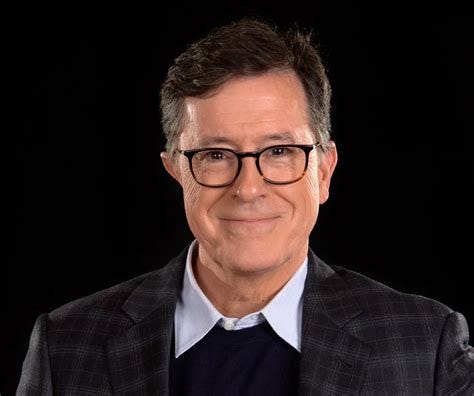
Colbert also found room in his show for religion, a topic that even after the election of Pope Francis really only had a place on late night as source material for jokes (and before the election very justifiably for ridicule). Colbert made Fr. James Martin, S.J. the official chaplain of The Late Show in 2021, as he had previously done on The Colbert Report, and the two talked about everything from Pope Leo to Martin’s latest books.
He also had no trouble talking about religious topics on his own. In 2012 he did a public conversation at Fordham University with Martin and then-New York Cardinal Tim Dolan about humor and the spiritual life. In 2017, he debated with atheist comedian Ricky Gervais on The Late Show about the existence of God. And he gave Gervais a lot of time to express his point of view, something atheists are rarely afforded in the public square. He also praised Gervais’ argument.
Simply in having guests and chats like this, Colbert established a place for religion in the broader social conversation. Without trying to—in fact precisely because he wasn’t trying to—he demonstrated that it’s actually kind of normal and no big deal to be a person of faith, as most Americans are, and to be a person who talks and reflects on their faith in the course of their ordinary lives, as most Americans quietly do.
In 2019, Colbert did a segment on CNN with Anderson Cooper. “You said in an interview that you had ‘learned to love the thing that I most wish had not happened,’ Cooper began, before suddenly breaking down into tears. “You went on to say, ‘What punishments of God are not gifts?’ Do you really believe that?”
“Yes,” Colbert said. “It’s a gift to exist. And with existence comes suffering, There’s no escaping that. And I guess I’m either a Catholic or a Buddhist when I say those things.”
“What do you get from loss?” Colbert asked. “You get awareness of other people’s loss. Which allows you to connect with that other person, which allows you to love more deeply and to understand what it’s like to be a human being.”
In a sense, that’s what his work on The Late Show came down to. Each night he looked into the camera and saw us sitting there, and often hurting. And he and his team responded with a program and a playfulness that they meant to help us.
I hope Stephen gets to see this. I always loved when his wife Evie was on. They glowed when they looked at each other. I’m glad he is getting the love and kudos he so deserves.
Wonderful tribute, thank you!